Let me guess. You’ve done the rounds — one doctor, then another. A scan showed cysts on your ovaries, you were handed a diagnosis and maybe a pill, and told to “just lose some weight.” But months on, nothing’s actually shifted, na? Your periods still do their own thing, your skin is throwing tantrums, the weight won’t budge, and by 4 pm you’re running on fumes.
If that’s you — read this one till the end.
PCOS actually has a new name now. It’s PMOS — Polyendocrine Metabolic Ovarian Syndrome. And they renamed it for the same reason nothing’s worked for you so far: it was never really about your ovaries.
So let me show you where the real problem sits.
Insulin
For most women, PMOS begins with one hormone behaving badly — insulin.
Insulin’s job is to manage your blood sugar. But when your cells stop listening to it, insulin keeps climbing. And all that extra insulin tells your ovaries to make more male hormones. That is your acne, your chin hair, your missing periods, your stubborn belly weight.
It’s also why PMOS never shows up alone. The same insulin problem quietly links it to type-2 diabetes, weight gain and stress — because stress and insulin feed each other in a loop. Calm the insulin down, and the whole system starts to settle.
Genetics
Yes, it runs in families. If your mother or sister has diabetes or PMOS, your chances go up.
But I tell every client the same thing — genetics only hands you the tendency. Your daily life decides whether it actually shows up. Carrying the gene is not the same as being stuck with it, and that part is fully in your hands.
What to look out for
- Irregular, long or missing periods
- Acne, oily skin, hair on the chin and jaw
- Thinning hair on your scalp
- Weight that sits around the middle and won’t budge
- Cravings and that classic 4 pm crash
- Mood swings, anxiety, restless sleep
Ticked a few? Don’t panic. This is not a life sentence — PMOS is one of the most fixable things I see in my clinic, the moment you stop chasing symptoms and start at the root.
And the root always shows up first in your bloodwork. So that’s exactly where we’ll start.
The blood work worth doing
Before you change a single meal, get the right tests done. Most women who walk into my clinic have had a scan and maybe a thyroid check — and completely missed the one test that explains everything.
Start with the one everyone skips:
- HOMA-IR – This is the big one. It tells you how insulin-resistant you are, often years before your sugar ever looks “high.” (If you want to watch this happen in real time, give continuous glucose monitoring a shot)
- Your hormones (do these on day 2–3 of your period, if you’re getting one):
- Total & free testosterone — the androgens behind acne, facial hair and hair fall
- SHBG — usually low when insulin is high, which is why free testosterone climbs
- DHEAS — tells us if your adrenals are adding to the androgen load
- LH & FSH — the ratio between them is often skewed in PMOS
- Prolactin — to rule out other reasons for missed periods
- AMH — usually runs high in PMOS, and tells us about your egg reserve
- HbA1c — your average blood sugar over the last 3 months
- Lipid profile — watch the triglyceride-to-HDL ratio; it’s a quiet insulin-resistance flag
- Thyroid — TSH, free T3, free T4 (add anti-TPO; thyroid trouble loves to travel with PMOS)
- Vitamin D — low levels make insulin resistance worse, and most of us are running low
One request: don’t self-diagnose off a single number. These tests only make sense when read together — and reading that story properly is exactly what a good practitioner is for.
Now — the part you actually came for. Food.
Food: your single biggest lever
This is where the real work happens. And it’s not as tough as internet can make it sound. You don’t need cut rice, or roti or carbs in general. You only need to play smart.
So what works? A few simple tweaks will change your health completely. Switch to a diet regime that is low carb, high protein, moderate fat, high fibre. Not zero-carb. Just smarter carb.
Because the whole game with PMOS comes down to one thing – keeping your blood sugar steady. Every spike pushes insulin up, and you already know what insulin does to your ovaries. So we build every meal to blunt that spike.
5 Rules You Should Follow:
- Never eat a carb alone. Poha on its own spikes you. Poha with peanuts, veggies and a side of curd doesn’t. Always pair carbs with protein, fibre and a little fat.
- Eat in the right order. Veggies and protein first, carbs last. Same meal, smaller spike.
- Push protein — we Indians eat far too little of it. Tofu, tempeh, dal with sprouts, chana, rajma, paneer, curd, nuts and seeds. Protein at every meal, breakfast included.
- Don’t fear fat. Ghee, nuts, seeds, cold-pressed oils — moderate amounts keep you full and steady.
- Fibre at every meal. Your salads, your sabzi, your millets, your whole dals.
Load up on the nutrients that do the heavy lifting — and they’re all already sitting in your Indian kitchen:
- Magnesium – pumpkin seeds, spinach, ragi, nuts
- Omega-3 – hemp seeds, flaxseeds, or simply supplement with a good algae based supplement
- Chromium & zinc – amaranth seeds, chickpeas, pumpkin seeds, rajma
- Your desi heroes: methi, dalchini, karela, jamun, amla — all quietly blood-sugar-friendly
What a day can look like:
- Breakfast: moong dal chilla loaded with veggies, or a tofu bhurji.
- Lunch: a bowl of salad with sprouts and veggies first, then dal, chawal and sabji.
- Dinner: keep it lighter and earlier. Rotate through — lentil pasta with veggies · a vegan frittata with mushrooms and spinach · ragda pattice with the veggies worked into the pattice · missi roti with mixed vegetable.
And anything else — only if your body actually needs it. Sometimes food can’t close the gap alone and a supplement earns its place: myo-inositol, omega-3, vitamin D, magnesium. But only once your bloodwork says so, and only the clean, third-party-tested kind. Supplements support the plate. They never replace it.
Beyond the plate
Food is only one quarter of the picture. My whole approach rests on what I call the Health Quartet — Food, Mind, Activity and Nature. You’ve sorted the food. PMOS needs the other three just as much, because insulin doesn’t only respond to what’s on your plate. It responds to how you sleep, how stressed you are, and how much you actually live.
Mind: sleep and stress
Sleep first. One bad night raises your insulin resistance the very next morning — that’s measurable, not a theory. Aim for 7–8 hours at a roughly fixed time. If PMOS has wrecked your sleep, fixing it isn’t a luxury — it’s part of the treatment.
Then stress. Cortisol, your stress hormone, pushes blood sugar up and tells your body to store fat around the middle — exactly what you’re working to undo. And something I see in my clinic every single day: the late-night bingeing, the sugar cravings, the “I was so good all day and then…” — that’s rarely about willpower. It’s your nervous system reaching for comfort. Soften the stress, and a lot of the cravings quieten on their own.
Nature: get some sun
Vitamin D behaves like a hormone, and low levels go hand in hand with worse insulin resistance and messier cycles. Ten to fifteen minutes of morning sun on your skin, most days, does more than you’d think — and that morning light also resets your body clock, which quietly improves both your sleep and your sugar.
Activity: make room for play
When did you last do something purely because it was fun? We adults forget how to play, and it costs us more than we realise. Movement you actually enjoy — dancing, a sport, a long walk with a friend, a proper belly laugh — drops cortisol, sharpens insulin sensitivity and lifts the mood dips PMOS loves to bring along. It doesn’t have to be a workout. It has to be joy. Your hormones respond to a life well-lived, not just a diet well-followed.
If you do just one thing, do this
I know that was a lot. If your head is spinning and you don’t know where to begin, don’t try to do everything. Do one thing.
Before lunch and before dinner, eat a bowl of vegetables first. That’s it. That’s step one.
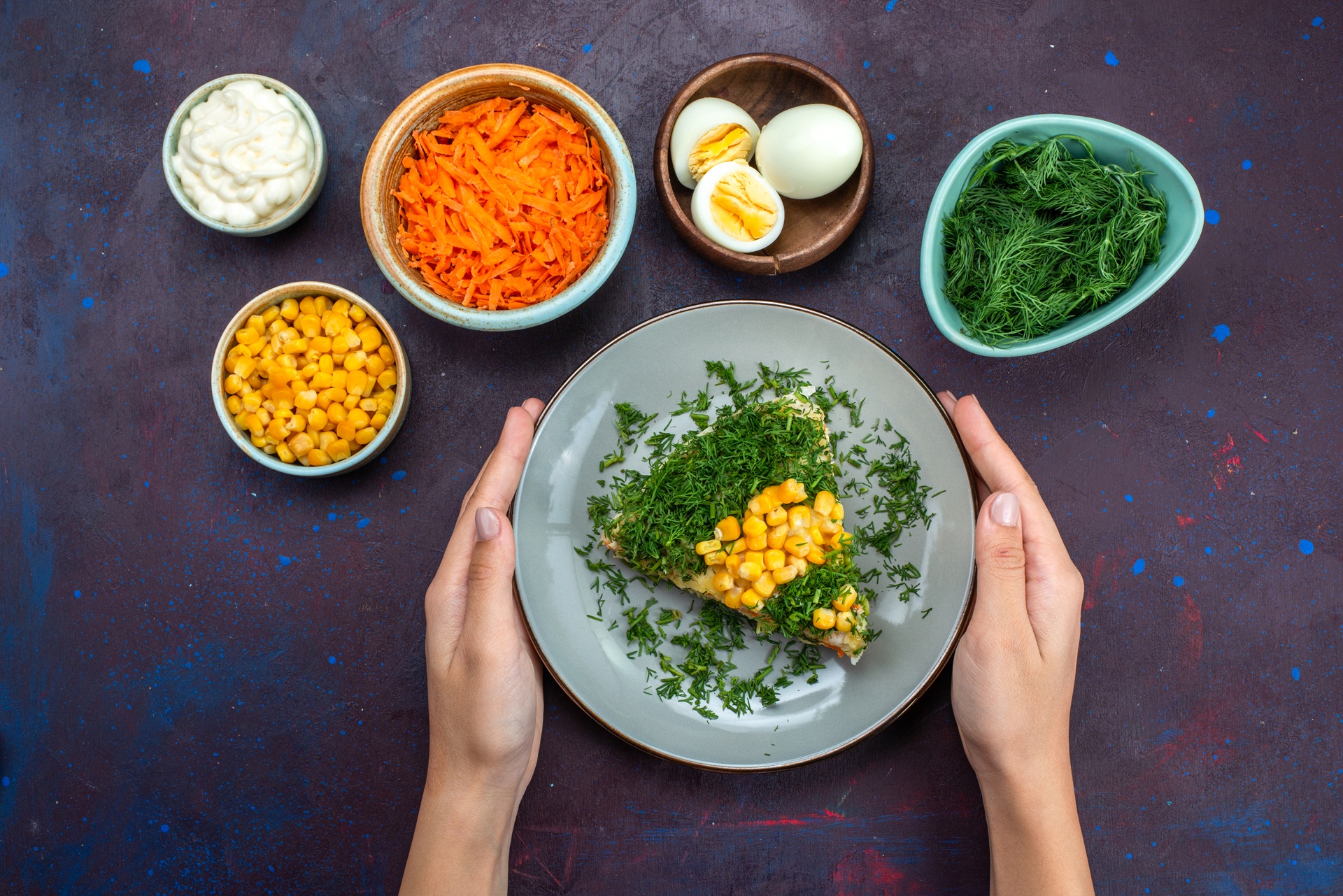
A bowl of salad — cucumber, tomato, carrot, grated beetroot, a handful of sprouts, a squeeze of lemon, maybe a sprinkle of seeds. Or lightly sautéed veggies if raw doesn’t suit you. Whatever’s in your fridge. Five minutes, no recipe to memorise.
Why this one habit? Because eating your fibre first slows down how fast sugar from the rest of the meal hits your blood. Smaller spike, calmer insulin — the whole goal of managing PMOS, done quietly at the start of two meals a day. It also fills you up, so the rice and the rest land in gentler portions without you forcing it, and it feeds the gut bacteria that help your hormones behave.
Do only this for the next two to three weeks. Once it’s automatic, you won’t have to think about it — and then we build the next habit on top. That’s how real change holds: one steady brick at a time, not a demolition.
FAQs
Is PCOS the same as PMOS?
Yes. PMOS — Polyendocrine Metabolic Ovarian Syndrome — is simply the new, more accurate name for PCOS, agreed through a global expert consensus in 2026. Same condition, better name — one that finally points at the metabolism instead of the ovaries.
What’s the most important blood test for PMOS?
HOMA-IR, worked out from your fasting insulin and fasting glucose. It catches the insulin resistance sitting under most PMOS, often long before your sugar ever looks abnormal.
Do I have to give up rice and roti?
No. You have to eat them smarter — veggies and protein first, sensible portions, never on their own. It’s the pairing and the order that flatten the spike, not cutting the carb out of your life.
Will losing weight fix my PMOS?
This one matters: for most women, the weight is a symptom, not the cause. Chase weight loss alone and you’ll fight your body. Fix the insulin at the root, and the weight very often settles on its own — without the misery.
One last thing
PMOS is not a life sentence, and it is certainly not your fault. It’s a body that’s been asking, for a while now, for a different kind of care — steadier meals, real rest, a little sun, and a lot more joy.
Start with the veggie bowl. Just that. Your body is always listening, and it responds faster than you’d believe.
And if you’d like a plan built around your body, your reports and your actual life — not a generic PCOS diet off the internet — that’s the work we do at The Health Pantry.